FedGWAS overview
FedGWAS is a federated pipeline for genome-wide association studies (GWAS). It helps multiple research centers run a coordinated GWAS workflow while keeping raw genotype and phenotype data under local control. The pipeline combines Flower-based federated orchestration, PLINK-compatible genetics processing, and privacy-aware relay protocols for multi-center association analysis.
Background
GWAS studies
Genome-wide association studies are large-scale statistical studies that test genetic variants across the genome for association with a trait or disease. A typical case-control or quantitative-trait GWAS combines genotype data, phenotype labels, covariates, quality-control filters, and an association model such as linear or logistic regression. The output is usually a table of variant association statistics, including effect estimates and p-values, which can be visualized with Manhattan and quantile-quantile plots.

GWAS results are association signals, not automatic proof of causality. Careful study design, sample quality control, variant quality control, population structure adjustment, relatedness handling, and replication are essential for interpretable results. Larger and more diverse cohorts can improve statistical power and generalizability, but many valuable datasets remain distributed across institutions.
Selected GWAS references:
- Uffelmann et al., Genome-wide association studies, Nature Reviews Methods Primers, 2021.
- Visscher et al., 10 years of GWAS discovery: biology, function, and translation, American Journal of Human Genetics, 2017.
Federated setting
Federated learning addresses this collaboration problem by moving computation to the data. In a federated GWAS setting, each center keeps its genotype and phenotype data locally, runs agreed-upon pipeline stages on its own infrastructure, and exchanges only configured protocol outputs with a coordinating server or with other participating clients. This model is useful when legal, ethical, governance, privacy, or data-size constraints make raw data pooling impractical.

Federation does not make a workflow private by itself. Intermediate statistics, model parameters, gradients, or partial data products can still expose information if the protocol is not designed carefully. Practical federated GWAS systems therefore combine local computation with measures such as secure transport, encrypted client-to-client messages, masking, secure aggregation, or cryptographic computation, depending on the threat model and performance budget.
Selected federated-learning and federated-GWAS references:
- McMahan et al., Communication-efficient learning of deep networks from decentralized data, AISTATS, 2017.
- Rieke et al., The future of digital health with federated learning, npj Digital Medicine, 2020.
- Nasirigerdeh et al., sPLINK: a hybrid federated tool as a robust alternative to meta-analysis in genome-wide association studies, Genome Biology, 2022.
- Wang et al., Privacy-preserving federated genome-wide association studies via dynamic sampling, Bioinformatics, 2023.
- Cho et al., Secure and federated genome-wide association studies for biobank-scale datasets, Nature Genetics, 2025.
What the FedGWAS pipeline does
FedGWAS implements a stage-based federated GWAS workflow, it solves the technical challenges of coordinating multi-client GWAS stages, and it provides a framework for developing and testing federated GWAS protocols.
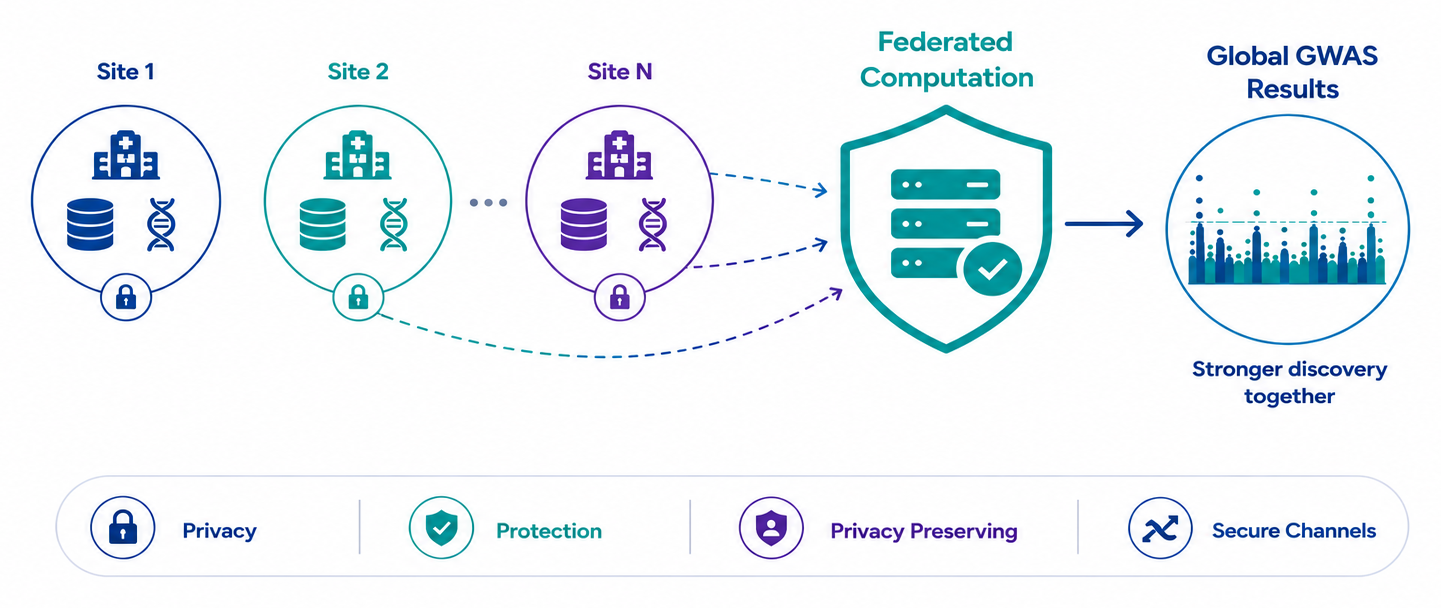
Its procedural stages include:
- Reads center-level genotype data in PLINK binary format, with optional VCF conversion where configured.
- Applies local and global quality-control checks for sample missingness, SNP missingness, minor allele frequency, and Hardy-Weinberg equilibrium.
- Performs ECC-backed client key exchange and encrypted client-to-client relay for protocol messages that should not be decrypted by the server.
- Uses pairwise pseudo-random masking where supported by the aggregation stage.
- Partitions anonymized genotype data for iterative KING kinship analysis.
- Runs local logistic-regression filtering and iterative federated association analysis.
- Organizes logs, intermediate files, result tables, and evaluation artifacts by center and experiment scenario.
The current implementation is intended for reproducible multi-center GWAS experiments, development of federated GWAS protocols, and deployment testing with real Flower server and client processes.
Operating modes
FedGWAS supports two primary ways to run the same core pipeline.
Simulation mode
Use simulation mode when you want to validate an installation, reproduce example
experiments, develop configurations, or compare federated outputs against a
centralized baseline on one machine. The recommended entry point is the
fedgwas-sim command-line interface, which can initialize a study directory,
prepare synthetic example data, validate configuration, run Flower local
simulation, generate a centralized baseline, evaluate results, and collect output
artifacts.
Start with Local Simulation for the guided setup, or see Simulation Mode and the fedgwas-sim CLI for the full command reference.
Deployment mode
Use deployment mode when the server and clients should run as separate Flower processes, usually on separate machines, containers, or terminals. In this mode, Flower SuperLink coordinates the federation and each SuperNode runs a client with its own center configuration and local data paths. This is the closest repository-supported workflow to a real multi-site deployment.
Start with Federated Deployment, then see Deployment Mode for SuperLink, SuperNode, port, and TLS details.
Start here
- Pre-requisites: Install Python dependencies, Flower, and PLINK.
- Local Simulation: Run a complete local multi-client simulation.
- Federated Deployment: Run FedGWAS with separate Flower server and client processes.
- Configuration: Understand center-level YAML settings and Flower run configuration.
- Pipeline Workflow: Follow each federated stage from key exchange through final logistic regression.
- Privacy and Masking: Review the current privacy mechanisms and limitations.
- Experiments: Explore shipped correctness, performance, and real-world experiment layouts.
License
FedGWAS is distributed under the MIT License. See the repository LICENSE for the full license text.